
The choice between white label and private label for a pharmacy fragrance line is a choice about ownership and time, not about quality. White label means starting from a scent that already exists and putting your name and packaging on it, which is fast and inexpensive but shared with anyone else who buys it. Private label means the scent is developed or adapted for you and held for your brand, which costs more and takes longer but gives the range something of its own to sell. The right answer depends on how much differentiation the shelf position actually requires.
Key takeaways
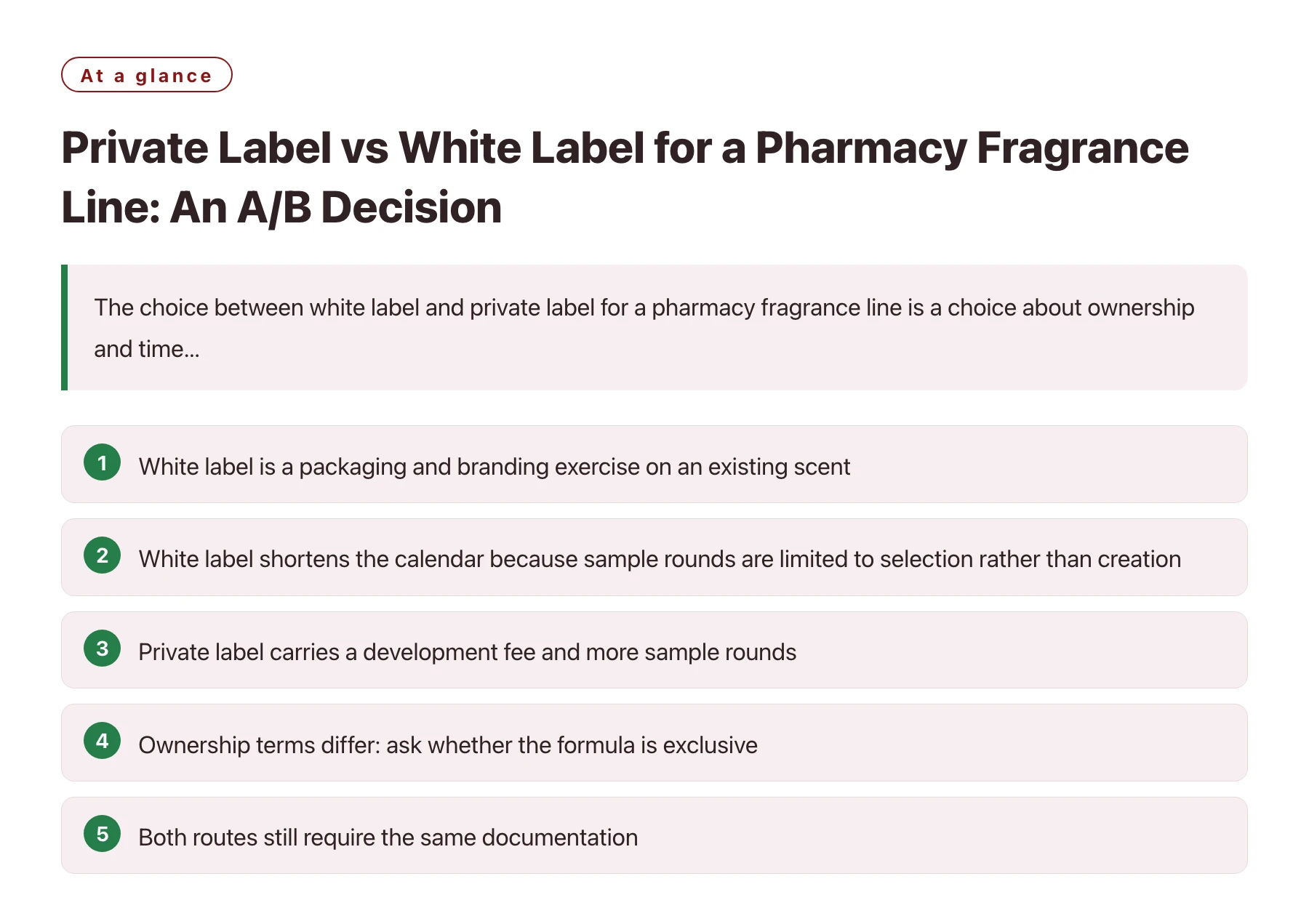
- White label is a packaging and branding exercise on an existing scent; private label adds development work so the formula is yours or exclusive to you.
- White label shortens the calendar because sample rounds are limited to selection rather than creation, which matters when a pharmacy listing has a fixed date.
- Private label carries a development fee and more sample rounds, and in return gives the range a scent argument that competitors cannot copy overnight.
- Ownership terms differ: ask whether the formula is exclusive, for how long, and what happens to it if the relationship ends.
- Both routes still require the same documentation, safety assessment and labelling work, so neither is a shortcut through compliance.
- A pharmacy range can mix the two, using white label for fast-moving essentials and private label for the hero product.
The two terms get used interchangeably in sourcing conversations, and that looseness causes real problems later. A buyer who expects exclusivity but has bought a library scent will eventually meet the same fragrance in a competitor's pack. A buyer who pays for development but only needed a fast filler product has spent money on differentiation the shelf position never required.
Pharmacy own-label ranges sit in a particular place in this decision. They are usually priced for a broad shopper, they often sit alongside a small number of national brands, and they are bought partly on trust in the retailer. That mix rewards a clear, well-described scent and reliable documentation more than it rewards novelty, which tilts the decision in a direction that is not obvious at first.
The comparison below sets white label and private label side by side across the points that change a launch. It is written as a decision framework rather than a recommendation, because the answer depends on the product's role in the range.
White label and private label, side by side
| Decision point | White label | Private label |
|---|---|---|
| Where the scent comes from | A library or stock fragrance the manufacturer already offers | A formula developed or adapted against your brief |
| Who else can buy it | Others may use the same scent, with different packaging and branding | Usually exclusive to your brand, or exclusive within a category or territory as agreed |
| Time to first sample | Days to a few weeks, because selection replaces creation | Several weeks to a few months, depending on rounds and complexity |
| Cost structure | No development fee in the usual case; cost sits in packaging, filling and minimums | A development fee plus materials, with a credit arrangement sometimes available against the bulk order |
| Differentiation | Low on scent, higher on pack, price and service | Higher on scent, which is useful for a hero product or a signature range |
| Risk if the product underperforms | Easy to discontinue, since no development investment is stranded | A development cost that has to be earned back, which raises the stakes on the launch forecast |
| Documentation burden | Same as private label: safety assessment, allergen declaration, labelling | Same as white label, plus documentation of the development and approval trail |
Read the rows as a trade between time and distinctiveness. Everything else, including compliance, is largely the same on both sides.
The question that decides it: what job does the scent do?
If the product is one of several value items in a larger own-label programme, its job is availability and price, and white label is usually the rational choice. The shopper is not looking for a signature; they are looking for something pleasant and inexpensive from a brand they already trust. Spending on development in that position produces a better scent that the shelf cannot charge for.
If the product is meant to carry the range, to be advertised, or to be the reason a shopper chooses the pharmacy over the supermarket, then the scent is part of the proposition and private label starts to earn its cost. The difference is real to the shopper: two identical fragrances in different packs compete on price, while a distinctive one can hold a higher price and survive a comparison.
There is also a defensive reason to develop. A white label scent can appear in a rival's packaging within a season, and there is nothing to do about it. Where the range has taken shelf space from a national brand, that is a risk worth pricing in.
A note on definitions is worth making early in supplier conversations. Some houses use white label fragrance manufacturing to describe branding an existing scent, others bundle it with light customisation. What matters is the answer to three factual questions: is this formula already in production, is it exclusive to me, and what is the development fee? an ODM partner for fragrance brands will normally describe the same choices in terms of who supplies the design and who supplies the brief.
Ownership, exclusivity and the end of the relationship
Exclusivity is the part of a private label agreement that buyers under-examine. Ask whether the formula is exclusive to your brand, exclusive within a product category, exclusive in a territory for a stated period, or not exclusive at all. Ask also what happens on termination: does the brand keep the right to continue production with another manufacturer, and does the formula transfer? A development project that cannot move with the brand is a lease rather than an asset.
Where a formula is developed, the approval trail matters as much as the formula. Keep the brief, the approved sample and the specification together, because they are what allow the scent to be reproduced by anyone, including a future supplier.
Compliance is a constant, not a variable
Buyers sometimes assume that a library scent is somehow already cleared and a developed scent is not. The reality is that the product on the shelf has to meet the same requirements either way, and the obligations attach to the brand named on the pack. In the EU, cosmetics are placed on the market under a framework that the European Commission summarises for manufacturers and importers, and the responsible person has to hold the safety assessment regardless of where the formula originated. [1]
The practical difference is documentary. A private label project generates a development history that has to be filed; a white label project should still come with the specification, the safety information and the allergen declaration for the product as sold. Testing houses such as SGS describe the cosmetic testing and verification services that support this work, from stability to microbiological checks, and those are the services a brand should expect to see named in a supplier's documentation list rather than inferred. [2]
Dosage and safe-use limits apply in both cases, and they are set by the product category rather than by the commercial model. A scent permitted in a fine fragrance is not automatically permitted at the same level in a body lotion, and the standards published by the International Fragrance Association are the reference a formulator works from. [3]
A mixed portfolio is often the real answer
Pharmacy groups rarely choose one model for everything. The pattern that works is a small number of developed scents where the range needs a signature, supported by library scents for the rest of the shelf. The developed products carry the story and the margin; the library products fill the range and the price ladder without a development budget behind each one.
That mix also gives the buyer a way to test the supplier before committing to development. Order a library scent first and judge the factory on filling, documentation and delivery; if those hold, spend the development budget on the hero product with the same partner. A buyer who wants to see what previous projects looked like can review examples of fragrance projects before the first meeting, and the pattern of those projects usually shows whether the house is stronger at library or developed work.
Whichever route is chosen, ask the supplier to price both. A manufacturer willing to quote a library option and a developed option for the same product, with the development fee shown separately, gives the buyer a real comparison instead of a single take-it-or-leave-it number. That quotation discipline is worth more in the decision than any presentation, and choosing a private label perfume partner is a reasonable checklist to apply while the comparison is still open.
Sources
- European Commission: Cosmetics in the EU —— The European Commission's overview of EU cosmetics rules, including the responsible person, product information file and safety report requirements.
- SGS: Cosmetics, Personal Care & Household Testing —— Testing, inspection and certification services for cosmetics and personal care, including microbiological, stability and safety testing aligned with cosmetics GMP.
- IFRA Standards Library (International Fragrance Association) —— The IFRA Standards Library lists the restrictions the fragrance industry applies to individual fragrance ingredients, based on safety assessments; it is the reference point for compliant fragrance formulation.
Frequently asked questions
Is white label the same as private label?
No, though the terms are often used loosely. White label usually means branding an existing stock scent; private label usually means a scent developed or adapted for your brand. What matters in a contract is whether the formula is exclusive, who owns it and what the development fee covers.
Which is faster for a pharmacy launch?
White label is faster, because the work is selection and packaging rather than development. Where a listing date is fixed and the product is a value item, that speed is often worth more than a distinctive scent.
Do I need a different safety assessment for a private label scent?
The product needs a safety assessment either way, and the responsibility sits with the brand named on the pack. A developed formula generates additional documentation around the development and approval trail, which should be filed alongside the safety information.
Can I switch from white label to private label later?
Yes, and it is a common path. Start with a stock scent to validate the range and the supplier, then develop a signature scent for the product that performs. Keep the brief and the approved samples for the second stage.
What should be in writing before any development starts?
Exclusivity terms, the development fee and any credit against bulk, the number of revision rounds, who approves the sample, and what happens to the formula if the relationship ends. Without those five points, the commercial model is undefined.