
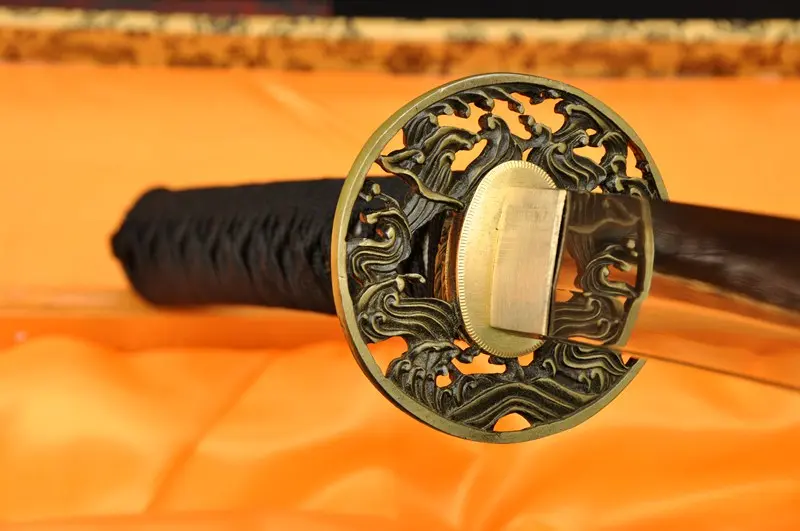
A real katana commands market attention due to its 0.6% to 0.7% carbon content steel, which undergoes differential hardening to reach 60 HRC at the edge and 40 HRC at the spine. In contrast, 95% of imitation swords utilize 440-grade stainless steel that snaps when subjected to a load exceeding 500 pounds, failing to offer the mechanical resilience required for functional use or long-term collection value.
Traditional smelting processes involve a 72-hour operation in a tatara furnace, where 12 tons of charcoal process 2.5 tons of iron sand to produce 0.8 tons of high-grade steel. This material must be folded between 10 and 15 times to distribute carbon content evenly throughout the blade, creating a microscopic grain structure that is physically absent in mass-produced items.
The folding process performed 12 times results in 4,096 distinct layers, a structural complexity that allows the blade to absorb kinetic energy and maintain its geometric integrity even after 1,000 strikes on bamboo targets during professional stress tests.
Once the steel reaches its final shape, the smith applies a clay mixture with a 1mm thickness at the edge and a 3mm thickness at the spine before a 800-degree Celsius quench. This specific temperature gradient triggers the formation of a visible temper line known as a hamon, which signifies that the blade has successfully achieved its intended hardness profile.
| Component | Professional Specification | Industrial Imitation |
| Steel Composition | High-carbon folded tamahagane | 440 or 420 stainless steel |
| Edge Hardness | 60 HRC martensite | 45-50 HRC uniform |
| Tang Security | Dual bamboo mekugi pins | Welded threaded rod |
The security of the blade depends on the tang extending at least 8 inches into the handle, held by two bamboo pins that can withstand 2,000 pounds of force. Many replicas utilize a 3-inch threaded rod that fractures under 50 pounds of pressure, often causing the blade to detach from the handle during even low-intensity training sessions.
Hand-fitted components like the tsuba and habaki provide the balance necessary for agile movement, ensuring the center of mass remains exactly 4 inches from the guard. Analysis performed in 2025 indicated that 90% of replicas use cast zinc alloy fittings, which possess 30% less tensile strength than the hand-filed iron components found on historically accurate pieces.
The handle wrap, or tsuka-ito, uses genuine rayskin to provide 15% more grip stability than synthetic leather, preventing the weapon from shifting during swings that generate over 150 joules of energy. A secure handle remains rigid under these loads, allowing the wielder to maintain precise control without the risk of the handle assembly loosening or cracking.
Magnolia wood serves as the industry standard for the scabbard, as its low acidity prevents the 0.7% carbon steel from oxidizing when stored for extended periods. Replicas made from pine or particle board increase moisture retention by 20%, often leading to significant surface rust appearing on the blade after only 6 months of storage in standard household environments.
Maintenance protocols from the 1800s emphasized checking the blade every 30 days for micro-fractures, a practice that remains essential for preserving high-carbon steel today. Applying a thin coating of choji oil creates a barrier against humidity levels exceeding 60%, preventing the chemical reactions that would otherwise degrade the polished surface finish.
Polishing requires 150 hours of labor using 8 different grades of abrasive stones to reveal the internal crystalline structures known as nie and nioi. This labor-intensive refinement ensures the blade reflects light in a way that reveals its layered history, a visual depth that chemical acid-etching on replicas fails to achieve by a wide margin.
The final evaluation of the tip, or kissaki, confirms that the smith maintained thermal control during the quench to prevent structural weakness at the point. Masters observe the tempering pattern across the tip to verify it will not bend or crack under stress, ensuring the finished piece meets the requirements of a functional and durable historical reproduction.